Seven types of neighbours. Seven different bushfire approaches. How to connect?
Those of us at the frontline of community engagement getting our communities ready for bushfire are always looking for ideas on how to reach more people in our community.
Something I’ve found super-helpful has been the bushfire evacuation archetypes research from Victoria. It helps me understand who I have in our community and what we need to do to connect with them.
Archetypes – that is, grouping people into clusters of common behaviours – offer a powerful way to understand how different people think about, prepare for and respond to bushfire, storm, cyclone and flood. They can also transform how effectively we undertake community engagement and messaging to motivate people to get ready for bushfire.
When we communicate to “the general public” as if it is one homogeneous group, we miss the real motivations, fears and constraints of many householders and our messaging and triggers completely go off target.
What archetypes are
In the emergency management context, an archetype is a typical kind of person defined by a pattern of attitudes, capabilities and likely actions under threat. Instead of segmenting people only by age or postcode, we can use archetypes to group them by how they see and personalize their bushfire risk, how confident they feel, and what they tend to do as a bushfire escalates.
Ken Strahan and his colleagues (Strahan & Gilbert, 2021; Strahan, 2019) developed seven archetypes from surveys – and these highlight that people’s decisions are not simply “stay/go or wait and see” but are shaped by experience, resources, social ties and trust in authorities.
Strahan’s bushfire self‑evacuation archetypes
Ken’s work on bushfire self‑evacuation identified seven archetypes that describe how householders in bushfire‑prone areas typically think and act before and during a fire, especially around evacuation. They give us real insights in what activities we can do in our community to connect with each group.
Considered Evacuators: These people acknowledge the threat, actively seek information, make a written or clear plan, and intend to leave early when risk thresholds are met.
Worried Waverers: These families and households do substantial property preparation and often acquire equipment, but doubt their own fire‑fighting ability and oscillate between staying and going as conditions change.
Community Guided: This group recognises bushfire as a threat but does little planning or preparation, rely heavily on neighbours, local leaders and media for cues, and evacuate when others do or when told.
Responsibility Deniers / Fatalists: These people either downplay the risk or see it as beyond their control, do minimal preparation and delay action, and sometimes wait for direct orders.
Experienced Defenders: People in this group have high self‑efficacy, equipment and some training; they intend to stay and defend and see themselves as competent decision‑makers under fire.
Dependent or Constrained (e.g. older adults, people with disabilities, limited transport or caring responsibilities): these people recognise their risk but face practical barriers to both preparation and evacuation.
Threat Dismissers / Unconcerned: This group underestimates their danger or is even oblivious to it, doesn’t prepare and may ignore warnings until very late.
From bushfire to storm, cyclone and flood
While specific preparation get ready activity differs between hazards (e.g. flammables from around the house vs sandbagging or securing roofs for flood and cyclone), many underlying archetypal groups have emerged from research in storm or cyclone preparation.
For example, perception of threat, sense of personal capability and level of social connectedness are critical drivers of readiness across cyclone, flood and storm hazards.
Research in a north Queensland community exposed to cyclone and flood found that high perceived threat, strong self‑efficacy and strong social connectedness predicted better preparation (King & Gurtner, 2017).
Community‑based and participatory approaches to disaster planning also show that engagement that builds local capacity and trust can shift how different “types” of residents prepare across hazards (Wells et al., 2013; World Bank & GFDRR, 2014).
For agencies planning off‑season campaigns, this means the bushfire archetype work can inspire parallel archetype‑based thinking for storm, cyclone and flood communication, even if specific archetype labels differ (McLennan, 2024; King & Gurtner, 2017).
Why archetypes matter for engagement
Using an archetype lens helps us move from generic risk messages to targeted engagement that aligns with people’s real decision patterns. Research shows that tailored messaging based on distinct archetypes can get better preparation, evacuation timing and overall safety than “one size fits all” campaigns (Strahan & Gilbert, 2021; Campbell et al., 2024; Strahan, 2019).
Archetypes show that there are barriers that can be overcome with specific community engagement tools.
They also show real opportunities: people who are socially connected or community‑guided can become amplifiers of preparedness messages when engagement leverages their networks.
But working in any community, you’ll know how hard it is to really focus on just two or three groups with your limited resources.
You want to reach everyone before the next big one!
Practical implications for messaging and local activities
Now let’s look at the messaging that Ken and his colleagues suggest (Strahan, 2019; Strahan & Watson, 2021; McLennan, 2024; King & Gurtner, 2017). I’ve added my experience:
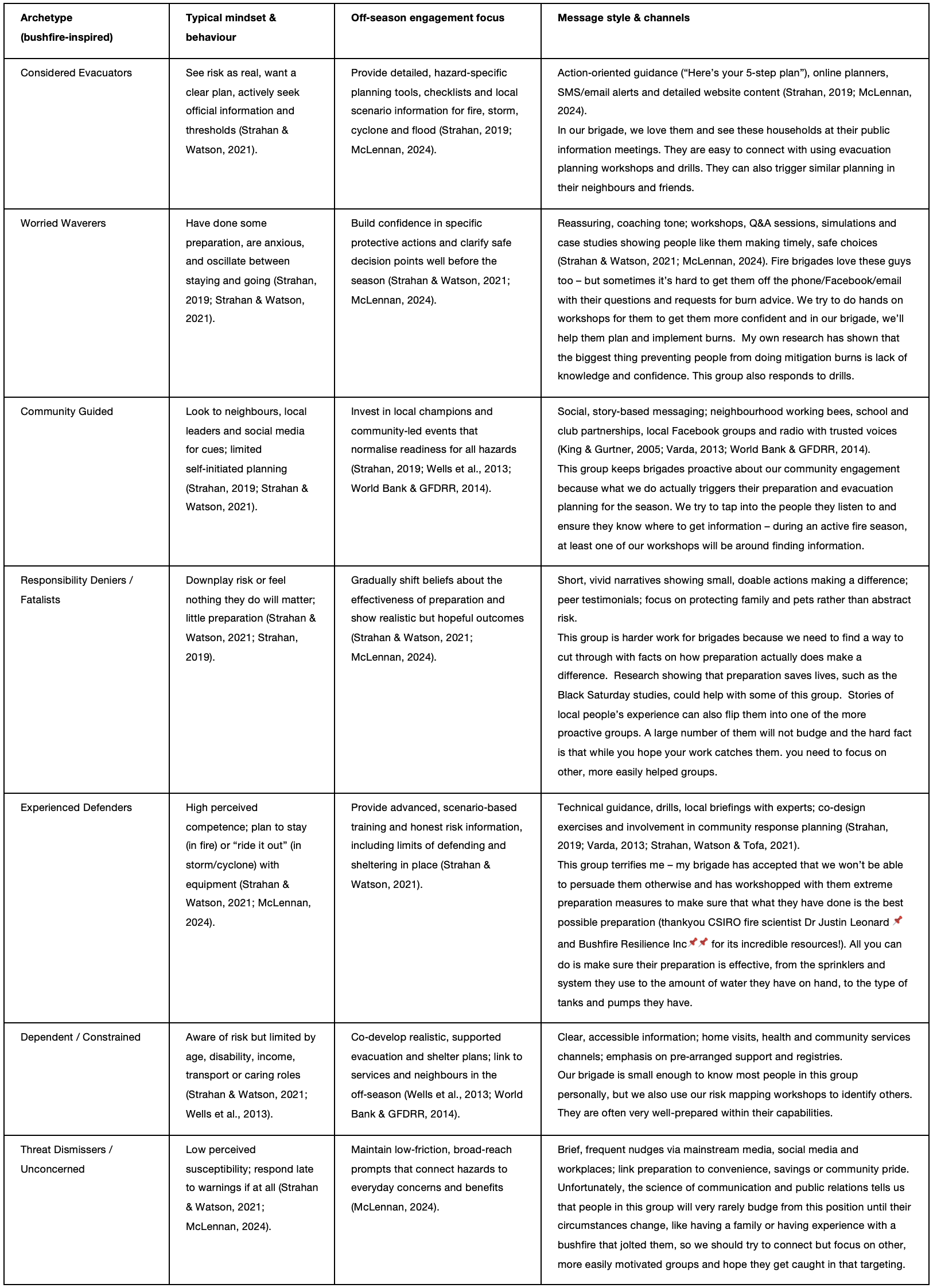
Planning campaigns around these archetypes encourages us to design layered strategies that speak differently to each cluster during the same season, rather than searching for a single “perfect” message (Strahan & Watson, 2021; McLennan, 2024).
It also provides a shared language across operations, community engagement and modelling teams, enabling scenario planning that reflects real behaviours rather than idealised ones (Strahan, 2019; Strahan & Watson, 2021).
Using the off‑season well
The off‑season is when agencies can map local communities against archetypes, test messages and build partnerships that will carry into the next fire, storm, cyclone and flood season (Strahan, 2019).
Off‑season activities can include community surveys, workshops and participatory planning processes that both identify local archetype mixes and build resilience (Wells et al., 2013).
This period is ideal for co‑developing campaigns with community organisations, refining archetype‑specific materials and training frontline staff to recognise and respond to different archetype needs in their day‑to‑day interactions (Wells et al., 2013; World Bank & GFDRR, 2014).
When you’re justifying your campaigns, activities and approach, you can integrate the insights of researchers.
Best of luck!
Barbara Ryan translates academic research results for use on the frontlines of communication and community engagement. She is especially interested in new science in emergency management and is a practicing volunteer community educator with her Rural Fire Service brigade in Queensland.
Reference list
Campbell, S.L., Williamson, G.J., Johnston, F.H. and Bowman, D.M., 2024. Archetypes and change in wildfire risk perceptions, behaviours and intentions among adults in Tasmania, Australia. International Journal of Wildland Fire, 33(11), p.WF24105.
Kanakis, K. and McShane, C., 2016. Preparing for disaster: preparedness in a flood and cyclone prone community. Australian Journal of Emergency Management, The, 31(2), pp.18-24.
King, D. and Gurtner, Y., 2017. Utilizing post‐disaster surveys to understand the social context of floods–experiences from Northern Australia. Flood Damage Survey and Assessment: New Insights from Research and Practice, pp.107-120.
Strahan, K., 2019, Application of bushfire self‑evacuation archetypes: Safer Together research report, Country Fire Authority, Melbourne.
Strahan, K., 2020. An archetypal perspective on householders who ‘wait and see’during a bushfire. Progress in Disaster Science, 7, p.100107.
Strahan, K.W. and Gilbert, J., 2021. Protective decision-making in bushfire part 2: A rapid systematic review of the ‘leave early’ literature. Fire, 4(3), p.42.
Strahan, K. and Watson, S.J., 2019. The protective action decision model: When householders choose their protective response to wildfire. Journal of Risk Research, 22(12), pp.1602-1623.
Singh, D., Strahan, K., McLennan, J., Robertson, J. and Wickramasinghe, B., 2021. What will they do? Modelling self-evacuation archetypes. arXiv preprint arXiv:2105.12366. Strahan, K & Gilbert, J, 2021, ‘An archetypal perspective on delaying evacuation’, Australian Journal of Emergency Management, vol. 36, no. 2, pp. 45–52.
Wells, K.B., Tang, J., Lizaola, E., Jones, F., Brown, A., Stayton, A., Williams, M., Chandra, A., Eisenman, D., Fogleman, S. and Plough, A., 2013. Applying community engagement to disaster planning: developing the vision and design for the Los Angeles County Community Disaster Resilience initiative. American journal of public health, 103(7), pp.1172-1180.
World Bank & Global Facility for Disaster Reduction and Recovery (GFDRR) 2014, Community participation and citizen engagement in disaster risk management, World Bank, Washington DC.