How do you best to communicate with volunteers. How much is too much? When is it not enough? What channels are best? What information do they need or want? Or do they want none at all?
I asked Perplexity AI to see what the researchers and specialist internal comms practitioners say and then compared this with what I’d been teaching on internal communication. This is what we came up with - the checked and verified version - and you’ll see much of what you already suspected in the results.
Effective internal communication in large volunteer organisations is strongest when a website/intranet acts as the hub, with a deliberately governed mix of channels (email, meetings, messaging, video, audio) that are segmented by role and preference and explicitly designed to support volunteer identification and retention. Academic studies and industry practice broadly confirm that communication quality, clarity of roles and relationships with supervisors, together with well‑run central communications, significantly influence volunteers’ attachment to the organisation and their intention to stay.
Role of the website as anchor
The website is where all information is found, with communications linking back to it. Studies of nonprofit and member‑serving organisations highlight the central role of a well‑structured website or intranet as the “single source of truth” that other channels point back to for detail, documents and updates. A central site reduces email overload, supports self‑service access to information, and helps avoid communication silos as volunteer programs grow.
Qualitative work with an all‑volunteer nonprofit shows that growth without an integrated internal communications hub leads to silos, “knowledge‑sharing tentativeness” and information gaps. Volunteer guidance and tool reviews likewise position the website or intranet as the “single source of truth” that centralises documents, calendars, FAQs and procedures for volunteers.
Research on volunteers highlights that information adequacy—having clear, accessible information about tasks, policies and the organisation’s activities—supports organisational identification, which in turn predicts intention to continue volunteering. A well‑designed, mobile‑friendly website or intranet is the main infrastructure for delivering that adequacy at scale, with other channels signposting back to it.
Key implications for design:
Treat the website/intranet as the hub: emails, SMS, social channels and meetings should link back to specific landing pages rather than trying to carry all content themselves.
Make navigation “task‑first”: volunteers should quickly find “What do I need to do?”, “When?”, “Who do I contact?” rather than organisational structures.
Balancing information needs - segmentation, overload and “not enough info”
Studies of member‑serving nonprofits find volunteers value informal, relational communication but become frustrated when essential information is fragmented, inconsistent or delivered too late. At the same time, a large‑sample employee surveys show people still prefer email and meetings for essential information, but often feel overwhelmed by volume and channel sprawl.
Volunteer‑specific quantitative research shows that high‑quality internal communication (including regular newsletters) increases volunteers’ organisational identification, which is strongly associated with retention. However, these effects are strongest when communications are targeted and supported by effective supervisor relationships, rather than generic messages to everyone.
Practical balancing strategies
Segment by role and engagement: distinguish highly active volunteers, occasional volunteers, leaders/coordinators and prospective volunteers; each segment needs different frequency and depth.
Offer preference tiers: allow volunteers to opt for “essential updates only”, “program‑specific news” or “all updates”, delivered via preferred channels (email, app notifications, SMS), reducing overload while not starving others of information.
Tie everything back to the website: use email, SMS and messaging to alert, summarise and link to specific website pages that hold the full detail, instructions and forms.
Core tools and channels – effectiveness and risks
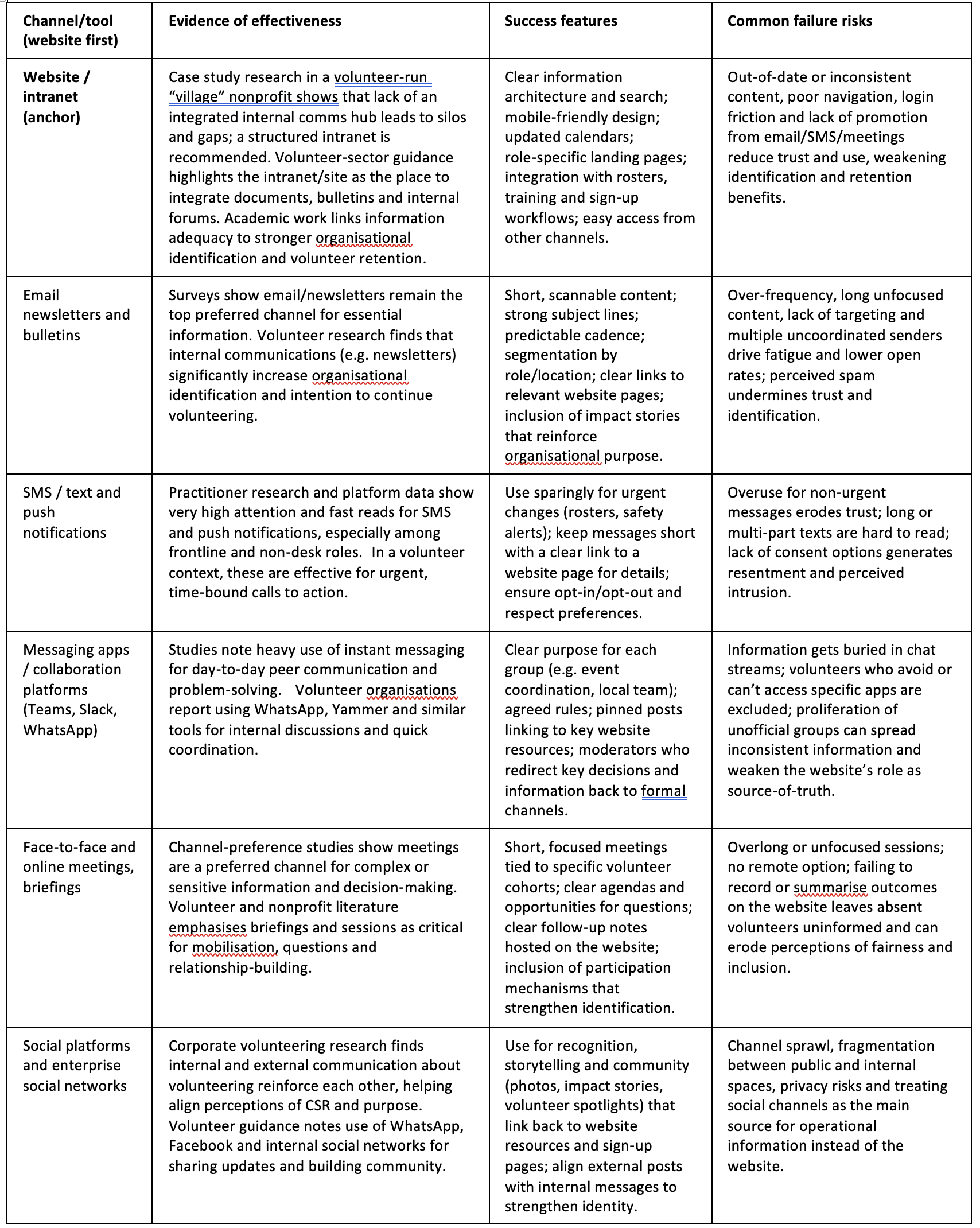
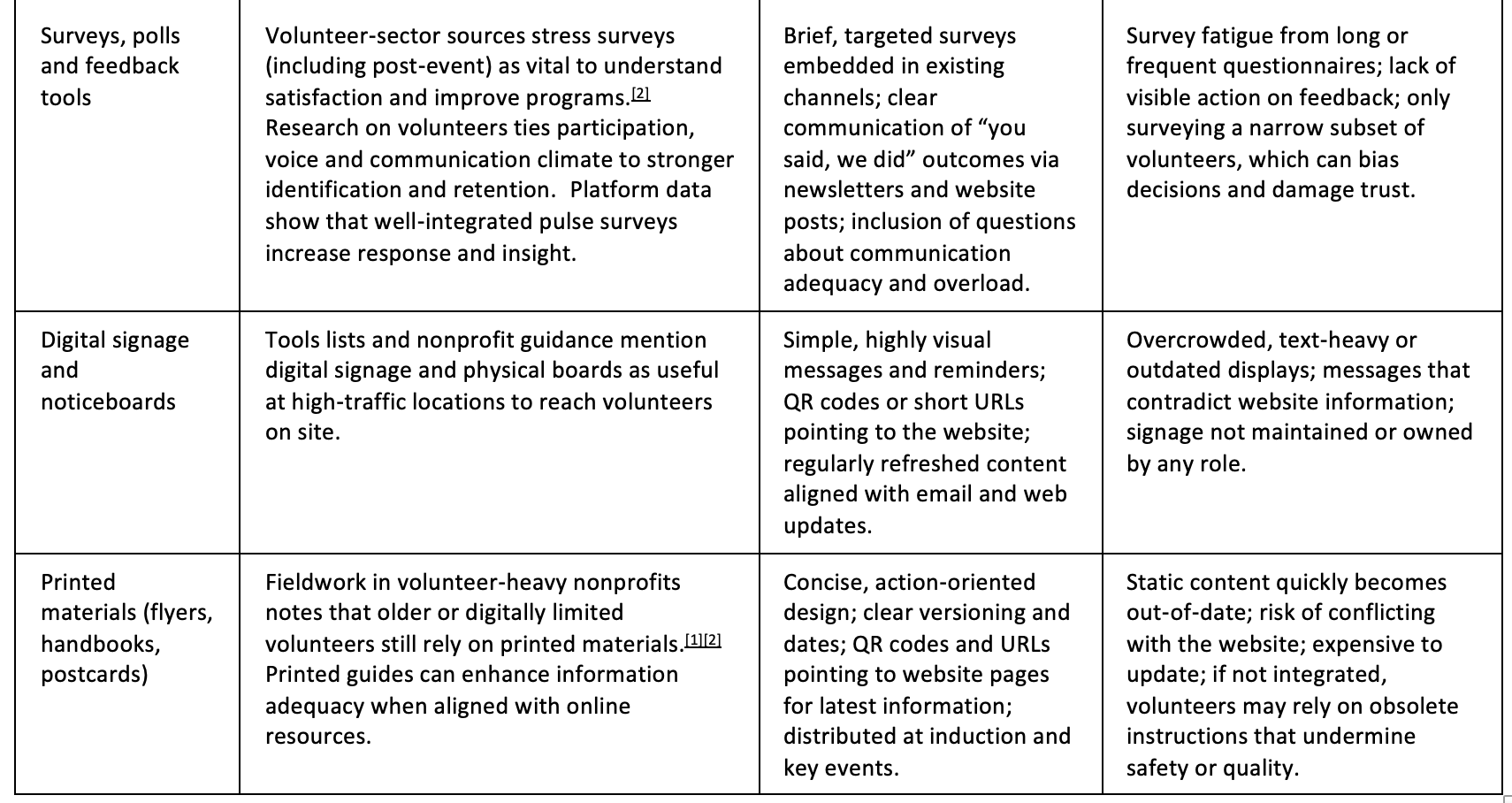
Timing, frequency and rhythm
Planned calendars rather than ad hoc blasts have been widely adopted by many volunteer organisations based on anecdotal and survey evidence provided by their members. Research on communication climate and identification supports this, showing that perceived information adequacy and predictability (knowing how and when information will come) contribute to stronger organisational identification and satisfaction.
Recommendations are to:
Establish a content calendar: for example, a weekly or fortnightly volunteer newsletter, monthly impact stories, and seasonal campaign bursts, all anchored on the website.
Time‑of‑day and day‑of‑week: compiled data from employee research suggests mid‑week and mid‑day sends outperform very early/late or weekend messaging, though testing with your own audience is essential.
Avoid last‑minute notices: volunteers report frustration when communication about shifts, training or major changes comes late or changes frequently. [1][3]
Language, tone and accessibility
Volunteer and employee studies converge on the importance of simple, inclusive and participative communication for building identification and commitment. Messages that clearly explain the “why” behind tasks and connect roles to organisational purpose are more likely to foster commitment and ongoing participation.
Implications:
Use of direct and connective language – use of ‘you’ and ‘us’, and getting the action or the ‘why’ early into a sentence to hook attention.
Use plain language and specific calls to action (task, location, time, requirements, support), always linking to a website page for fuller instructions.
Electronic newsletter format, where a strong and interesting first paragraph gives key points with the option to click a link to learn more, is recommended. The link would lead to an article on Sharepoint or the website. Vision 6 and other newsletter platforms allow you to measure click through and time spent on pages rates.
Emphasise impact and purpose: share stories about beneficiaries and community outcomes; academic studies of volunteering show that this approach strongly vindicates a person’s decision to join, and reinforces identification with their brigade/region or the wider service.
Ensure accessibility with clear layout, adequate contrast, alt‑text, translations where needed, captions and transcripts for video and audio, which is especially important for older volunteers or those with impairments.
Videos: evidence on effectiveness and identification
Internal video is widely used for leadership messages, change communication and training, with case studies and practitioner research reporting improved engagement, understanding and trust when video is used appropriately. Media richness research suggests video is especially effective for equivocal or emotional topics, where tone and non‑verbal cues matter.
Volunteer research on communication practices shows that richer, more personal interactions—including supervisor communication and storytelling—are associated with stronger identification. Internal video can approximate some of these benefits at scale if volunteers cannot regularly meet leaders or coordinators face‑to‑face.
Reported advantages:
Humanising leaders and coordinators, which can be especially valuable where volunteers rarely meet central staff.
Conveying emotion and nuance around sensitive topics (e.g. safety changes, major restructures) more effectively than text alone.
Supporting micro‑learning and just‑in‑time training through short “how‑to” clips.
Best‑practice formats
Keep update videos short (often 2–5 minutes), with a single clear purpose and explicit calls to action, plus a link to a website page for details or resources.
Use recognisable speakers and locations (e.g. volunteer leaders, active sites) to strengthen relatability and identification.
Host or embed videos on your website’s relevant sections—onboarding, “how‑to” pages, campaign hubs—and promote them via email and messaging, rather than scattering links.
Provide captions and transcripts to improve accessibility and allow volunteers to skim or read instead of watching when short on time.
When videos fail to engage
Long or dense videos produce steep drop‑off curves; volunteers may disengage before key messages.
Poor audio or visuals can reduce perceived professionalism and trust, with less benefit than a concise, well‑written text bulletin. Poor production values (bad audio, confusing visuals) are more damaging than simple but clear “talking head” videos.
Hosting videos in hard‑to‑find locations or sending video links without any on‑page summary or alternative format reduces accessibility, especially for low‑bandwidth users.
Podcasts and audio for internal communication
Large‑scale preference research shows that podcasts and internal audio are still niche compared to email, meetings and websites as primary channels for essential information. The accessibility of podcasts and the ability to listen while doing other mundane tasks like driving makes the appealing – and internal communications practitioners and corporate volunteering programs are testing podcasts for deeper storytelling, interviews and culture‑building.[6][11][19] In fact, there are podcasts devoted to internal communication like Engaging Internal Comms.
In line with volunteer identity research, podcast storytelling can strengthen sense of belonging and identification, but only if volunteers actually listen and if stories clearly connect to organisational purpose and values.
Potential advantages:
Convenience for volunteers who travel, have long commutes or perform repetitive tasks where listening is feasible.
Ability to explore complex topics (impact stories, interviews with volunteers, deep‑dives into programs) without overloading email or meetings.
Best‑practice formats
Use short, predictable episodes (around 10–20 minutes) with clear themes (“Volunteer stories”, “Program spotlight”, “Coordinator conversations”) to build listening habits.
Always host episodes on the website (with show notes, key quotes and links) and promote them through email newsletters and social posts so that the podcast remains an optional, enriching layer rather than a hidden channel.
Include calls to action and direct links to sign‑up or information pages on the website to convert listening into engagement.
The podcast has tight production values where the recording has been edited for easiest listening.
When podcasts don’t generate engagement
Low discoverability if episodes are not embedded and promoted on the website and in existing channels (that is Apple Podcasts or Google Play); listenership then remains small and skewed.
Using podcasts for critical instructions or time‑sensitive updates is risky, as evidence shows few people choose podcasts as their primary channel for essential information.
Overly long, unstructured episodes without show notes, transcripts or clear segmentation discourage busy volunteers from engaging.
When a long form interview has been uploaded with little or no production apart from the addition of an introduction/theme and a wrap up.
Designing a best‑practice program for large volunteer organisations
1. Architecture: hub and spokes
Website/intranet as authoritative hub for policies, rosters, training, FAQs, contact details and forms, directly supporting information adequacy and clarity.
Spokes (email, SMS, messaging, meetings, social media, video, podcasts) primarily highlight and contextualise content, always pointing back to specific website pages rather than duplicating everything.
2. Segmentation, personalisation and supervisor role
Segment communications by role, geography and engagement level, using tools that support audience targeting and analytics.
Recognise that supervisor or coordinator communication is a major driver of volunteer identification and retention; give these leaders templates, training and aligned messaging that complement central communications and the website.
3. Feedback, participation and communication climate
Integrate short surveys and quick polls into newsletters, website and events to track perceptions of information adequacy, overload and trust, then respond visibly. [2][4][9]
Create participation spaces—Q&A forums, consultative sessions, volunteer advisory groups—so volunteers feel heard; research links participation and fair communication climate to stronger identification and retention.
4. Governance and channel frameworks
Establish simple internal communications guidelines: who sends what, through which channels, for each tool (website, email, SMS, messaging, video, audio, social), its purpose, typical content, audience, sender, frequency and success measures.
Provide standard templates (emails, briefing notes, slide decks, video scripts) and brand guidelines to maintain consistency and reduce cognitive load on volunteer leaders.
5. Culture, purpose and recognition
Consistently connect volunteer opportunities and stories to organisational mission and values across website, email, social, video and audio; academic research shows this alignment strengthens corporate and volunteer identification.
Recognise and celebrate volunteers publicly across channels—website profiles, newsletter spotlights, meeting shout‑outs, social posts—as recognition content is often among the most engaging and reinforces commitment.
Summary
The evidence for a structured volunteer comms approach is strong in terms of keeping people engaged and striking a balance for those who want to work at very local level and those who want to be involved more widely and actively. It could be achievable without dedicated staff, but initial co-ordination by your media and comms department will be important to oversee a management level training program as well as platform review and, if needed, setup. These professional communicators, some of whom may have come from a corporate internal comms background, can provide a great deal of advice in this area, so I’d recommend talking to them about further steps.
Barbara Ryan is a researcher who synthesises the knowledge and academic research that’s out there on a huge range of problems and translates it for practical application to solve problems for organisations. She then helps frontline users of the knowledge adapt it to their own practice.
Sources for this article – great for deeper reading
1. Hanshaw, Charis, "Channeling (Com)passion: Exploring the Strategic Potential of Internal Communications in Member-Serving Community Nonprofit Organizations" (2021). Master's Projects and Capstones. Available at: https://repository.usfca.edu/capstone/1238. Accessed March 9, 2026.
2. Xarxanet and partners (2018) ‘10 useful internal communication channels for volunteering organisations’, Nonprofit.Xarxanet.org. Available at: https://nonprofit.xarxanet.org/news/10-useful-internal-communication-channels-volunteering-organizations. Accessed: March 9, 2026)
3. Bauer, Steven and Lim, Dongkuk, "Effect of communication practices on volunteer organization identification and retention" (2019). Pepperdine University, All Faculty Open Access Publications. Paper 72. Available at: https://digitalcommons.pepperdine.edu/faculty_pubs/72. Accessed March 9, 2025.
4. Axios HQ (2024) ‘The communication channels employees want leaders to use’, Axios HQ Insights, 20 October. Available at: https://www.axioshq.com/insights/the-communication-channels-employees-want-their-leaders-to-use . Accessed March 9, 2026.
5. Gallagher, A. J. (2024) ‘Employee Communication Channel Trends’, Arthur J. Gallagher & Co., 26 February. Available at: https://www.ajg.com/employeeexperience/insights/2024/february/channel-trends/ . Accessed March 9, 2026.
6. Axios HQ (2024) ‘Apps, IMs, and intranets aren’t where employees want essential communications’, Axios HQ Insights, 5 March. Available at: https://www.axioshq.com/insights/apps-ims-and-intranets-arent-where-employees-want-essential-communications . Accessed March 9, 2026.
7. Malouf, A., Selaković, M. and Ljepava, N. (2016) ‘Exploring the Relationship Between Corporate Volunteering and Internal Communications in Multinational Organizations’, Communication Management Review, 1(2), 36–57. Available at: http://www.commreview.hr/download/documents/read/maloufselakovicljepava_15 . Accessed March 9, 2026)
8. Smith, Suzanne (2024) ‘Following Southwest Airlines’ Model for Taking Nonprofit Internal Communications to New Heights’, Social Impact Architects Blog, July 17. Available at: https://socialimpactarchitects.com/nonprofit-internal-communications/ . Accessed March 9, 2026.
9. Hure, Christina (2024) ‘10 Best Internal Communication Tools, Software, Platforms for 2026’, ContactMonkey Blog, 20 September. Available at: https://www.contactmonkey.com/blog/internal-communications-tools . Accessed March 9, 2026.
10. Relic, Jelena (2026) ‘10 Best internal communication tools for keeping everyone in the loop’, ThriveA Blog, 25 January. Available at: https://thrivea.com/blog/best-internal-communication-tools/ . Accessed March 9, 2026).
11. AxiosHQ (2025) ‘The communication channels employees want leaders to use’, Axios HQ Insights, April. Available at: https://www.axioshq.com/insights/the-communication-channels-employees-want-their-leaders-to-use. Accessed March 9, 2025.
12. Spike (2024) ‘How do Employees Communicate in 2024? Workplace Communication and Collaboration Study’, Spike Blog. Available at: https://www.spikenow.com/blog/spike-news/workplace-communication-and-collaboration-study/ . Accessed March 9, 2026.
13. Siddhant, Kumar (2026) ‘Internal Communication in Employee Volunteering: How to turn awareness into sustained participation’. Goodera, February. Available at: https://www.goodera.com/blog/internal-communication-in-employee-volunteering . Accessed March 9, 2026.
14. Elcom (2025) ‘22 Employee Newsletter Ideas to Boost Internal Comms’, Elcom Blog, 5 August. Available at: https://www.elcom.com.au/resources/blog/engaging-employee-newsletter-ideas Accessed March 9, 2026.
15. Vegiahyan, K.D., Baghestan, A.G. & Asfaranjan, Y.S. (2013) ‘Exploring Employees Preferences of Communication Channel’, Middle East Journal of Scientific Research, 18 (4), pp. 504-511. Available at file:///Users/barbararyan/Downloads/Exploring_Employees_Preference_of_Commun-2.pdf. Accessed March 9, 2026.
16. Bui, S. (2022) ‘Can internal communication videos leverage employees’ working results?’, eLearning Industry, 31 January. Available at: https://elearningindustry.com/can-internal-communication-videos-leverage-employees-working-results . Accessed March 9, 2026.
17. Hive Streaming (2025) ‘The power of internal video communication for company-wide engagement’, Hive Streaming Resources, 26 February. Available at: https://www.hivestreaming.com/resources/the-power-of-internal-video-communication-for-company-wide-engagement . Accessed March 9, 2026).
18. Brunton, Zoe (2025) ‘Case study: Lights, camera, strategic action’, Institute of Internal Communication IoIC Resources, 3 June. Available at: https://www.ioic.org.uk/resource/case-study-lights-camera-strategic-action.html . Accessed March 9, 2026.
19. Smith, Craig (2024) ‘Engaging Internal Comms’, Apple Podcasts. Available at https://podcasts.apple.com/gb/podcast/engaging-internal-comms/id1515912940 (144 episodes on a wide range of topics)